Table of Contents
- Are meeting room occupancy sensors privacy-friendly?
- Why privacy questions come up
- Occupancy is not the same as identity
- Sensor types and privacy considerations
- What employees should be told
- How GOGET supports privacy-friendly room sensors
- Final thoughts: choose sensors that solve the problem without collecting too much
Are meeting room occupancy sensors privacy-friendly?
They can be, but it depends on the technology and how the data is used.
A privacy-friendly meeting room occupancy sensor should answer a simple operational question: does this room appear to be in use? It should not identify employees, record conversations, capture faces, or track individual behavior.
This distinction is important. The European Commission explains personal data as information relating to an identified or identifiable person, including information that can identify someone indirectly when combined with other data. That means buyers should evaluate not only the sensor itself, but also whether the wider system links occupancy signals to individuals.
For meeting rooms, the best privacy posture is usually to collect the minimum signal needed for the workplace use case.
Why privacy questions come up
Employees may worry that office sensors are being used for monitoring rather than room management. This concern is understandable, especially when sensor projects are introduced without clear communication.
The UK Information Commissioner’s Office notes that employee monitoring can be intrusive if it is not handled transparently and proportionately. For buyers, this creates a practical requirement: room sensor projects should be easy to explain. Employees should understand what is detected, why it is used, and what is not collected.
Occupancy is not the same as identity
A core principle of room occupancy sensor privacy is that occupancy data should not be confused with identity data.
Occupancy means the system detects a room-use signal. Identity means the system knows who is present.
For most room-booking use cases, identity is not required. Workplace teams typically need to know whether a booked room appears unused, whether a room may be released early, or how often meeting spaces are used over time. Those use cases can often be supported with anonymous room-level signals rather than employee-level tracking.
This is especially important for meeting rooms because meetings may include sensitive discussions, visitors, candidates, customers, or employee representatives. A room sensor should help manage the space, not expose the meeting.
Sensor types and privacy considerations
Different sensor technologies create different privacy questions.
PIR or motion sensors
PIR sensors detect infrared changes associated with presence or movement. They do not take images, record audio, identify people, or count individuals unless combined with separate validated capabilities. For many meeting-room use cases, this makes PIR a strong privacy-friendly option.
Radar sensors
Radar sensors can detect presence and movement, sometimes with more sensitivity than basic motion sensors. They may be useful in some spaces, but buyers should still ask what data is processed, whether people can be inferred individually, and how long data is stored.
Camera-based sensors
Camera-based detection can create greater privacy challenges because cameras may capture images, faces, behavior, meeting context, whiteboards, or documents. The European Data Protection Board’s guidance on video devices is a useful reference point for understanding why video-based monitoring requires careful purpose, transparency, and data-protection review.
This does not mean every camera-based system is automatically unsuitable. It does mean buyers should expect a higher privacy review burden, clearer signage and communication, stricter access controls, and stronger justification.
Badge, Wi-Fi, or Bluetooth tracking systems
Systems based on badges, phones, Wi-Fi, or personal Bluetooth signals can be useful for some workplace analytics, but they may also connect space usage to identifiable employees. That changes the privacy conversation from room usage to employee tracking.
For room presence sensor privacy, buyers should ask whether the system detects the room or tracks the person.
What employees should be told
Clear communication is one of the simplest ways to build trust. Before deploying room sensors, explain:
- What is detected: for example, presence or movement in a meeting room.
- Why it is used: for example, to reduce no-shows, release unused rooms, and improve space planning.
- What is not collected: for example, no names, images, audio, biometric data, or meeting content.
- How data is handled: including retention, access, reporting, and whether data is aggregated.
- Who to contact: for questions from employees, visitors, managers, or works councils.
This helps employees understand that the goal is better room management, not surveillance.
How GOGET supports privacy-friendly room sensors
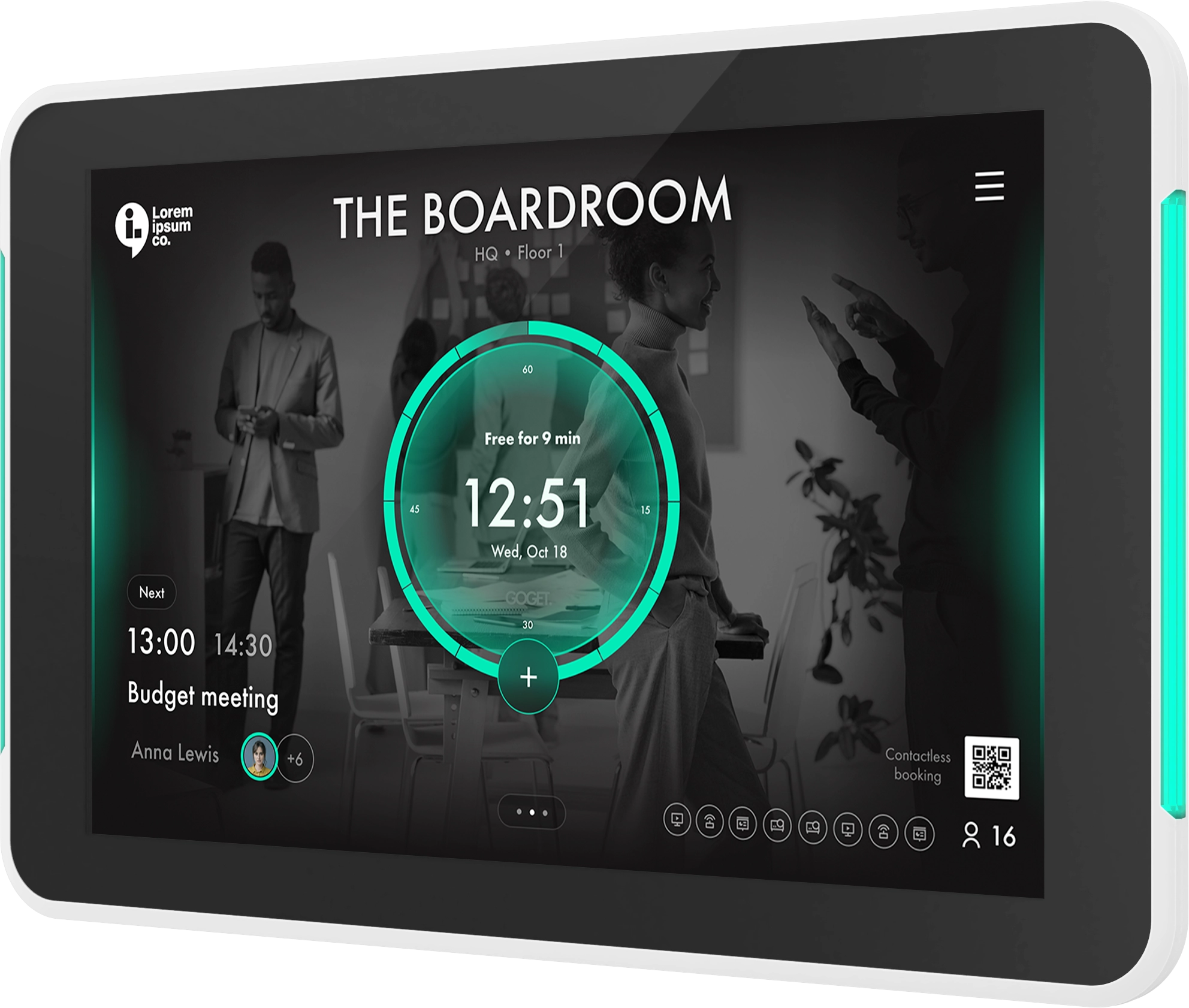
GOGET’s room sensor approach is built around anonymous presence signaling. It detects motion to determine whether a space is in use, with sensors communicating directly with an assigned GOGET One meeting room display via BLE.
The sensor setup does not require separate gateways, hubs, extra servers, extra wiring, programming, or third-party services. This helps reduce infrastructure complexity while keeping the room sensor connected to the meeting room display ecosystem.
The key privacy point is the sensor data itself: its occupancy sensor emits a hexadecimal data frame with no personal data and frames the behavior as anonymous and passive.
In practical terms, this means GOGET can support meeting-room automation and space insights without requiring the room sensor to identify, film, listen to, or count meeting participants. The sensor provides a room-level presence signal, not a personal profile.
That is the main reason GOGET’s BLE sensor setup is a strong fit for buyers evaluating room occupancy sensor privacy. It helps answer the operational question: “is the room in use?” while preserving participant privacy at the sensor-signal level.
When configured for supported workflows, GOGET room sensors can help connect room bookings with real-world presence signals, support check-in or release workflows, and give workplace teams clearer data for planning. These outcomes should still be implemented with appropriate policies, communication, and customer-specific privacy review.
Final thoughts: choose sensors that solve the problem without collecting too much
The best room sensor strategy is not the one that collects the most data. It is the one that collects the right data for the business problem.
For many organizations, that means choosing a privacy-conscious occupancy signal instead of camera-based monitoring or employee tracking. A PIR/BLE sensor can help workplace teams understand room usage while avoiding unnecessary collection of personal information.
For buyers comparing room sensor options, the practical question is simple: can the system improve room utilization without compromising trust?
GOGET Room Sensors are designed to provide anonymous, passive room-presence detection as part of the GOGET One ecosystem, helping organizations improve room visibility while protecting the privacy of meeting participants.